Norton Private Browser
- 4.2
- Rating
- 500.00K
- Installs
- Free
- Price

 Analysis by App-foxy
When I want to open a link without bringing a pile of advertising clutter along with it, I look for a browser that feels straightforward rather than overloaded. Norton Private Browser is NortonMobile’s communication-focused app for Android and iOS, built around private browsing and ad blocking. I used it with ordinary tasks in mind: opening a search result, moving between pages, signing into a service, and handing a link from another app into the browser. My overall impression is that it is easiest to appreciate when the starting problem is simple: a page is slow, crowded, or uncomfortable to browse.
The app is free and suitable for Everyone, which makes it easy to try without turning the decision into a financial commitment. It has an average rating of 4.0 from around 1,600 ratings, with more than 500,000 installs. Those figures suggest a reasonably established audience, although they do not tell me whether it will suit every browsing habit. The more useful question is how it behaves during a complete everyday workflow, from receiving a link to finishing the task.
From an unwanted link to a cleaner browsing session
When I open a link I didn’t ask for—perhaps a promotion buried in a chat—I want to decide quickly whether it is worth my attention without letting it disrupt my usual browsing setup. In this section, I look at how Norton Private Browser can serve as a separate place to inspect that link, and why a simple handoff can make the browsing session feel more intentional.
You May Also Like

 Blood Strike: 2.5 Anniversary
Blood Strike’s Loadouts Turn Every Drop Into a Tactical Gamble
A close look at Blood Strike’s custom loadouts: how fast access to signature weapons reshapes its battle royale rhythm, rewards preparation, and narrows the gap between fights.

 Pandora - Music & Podcasts
Pandora’s Music Is Easy to Start, but Harder to Recover
Pandora’s strength is its low-effort path from a seed to a station. Its weak spot is how much confidence it asks you to place in connection, setup, and quiet recovery.

 8 Ball Pool
 Is Built on Rivalries, Rematches, and Routine
A close look at the rivalries, rematches, shared routines, and unanswered safety questions that turn a quick pool match into a persistent mobile community.

 Samsung Music
’s Quiet Strength Is Playing What You Already Own
Its reach comes less from spectacle than from dependable access to a personal library. That simplicity is both the app’s strongest retention engine and its ceiling.

 AccuWeather: Weather Radar
AccuWeather Review: A Quick, Clear Forecast for Everyday Decisions
For everyday plans, the best forecast is the one you can understand quickly. AccuWeather makes rain timing, radar, and local conditions easy to act on, with a few trade-offs.

 Hill Climb Racing
Why Hill Climb Racing Still Turns Crashes Into One More Run
A tiny car, a bumpy hill and one more upgrade: Hill Climb Racing keeps resurfacing because its simple chaos makes every near-miss feel personal.
More From Our News Desk



Starting with the link I actually need
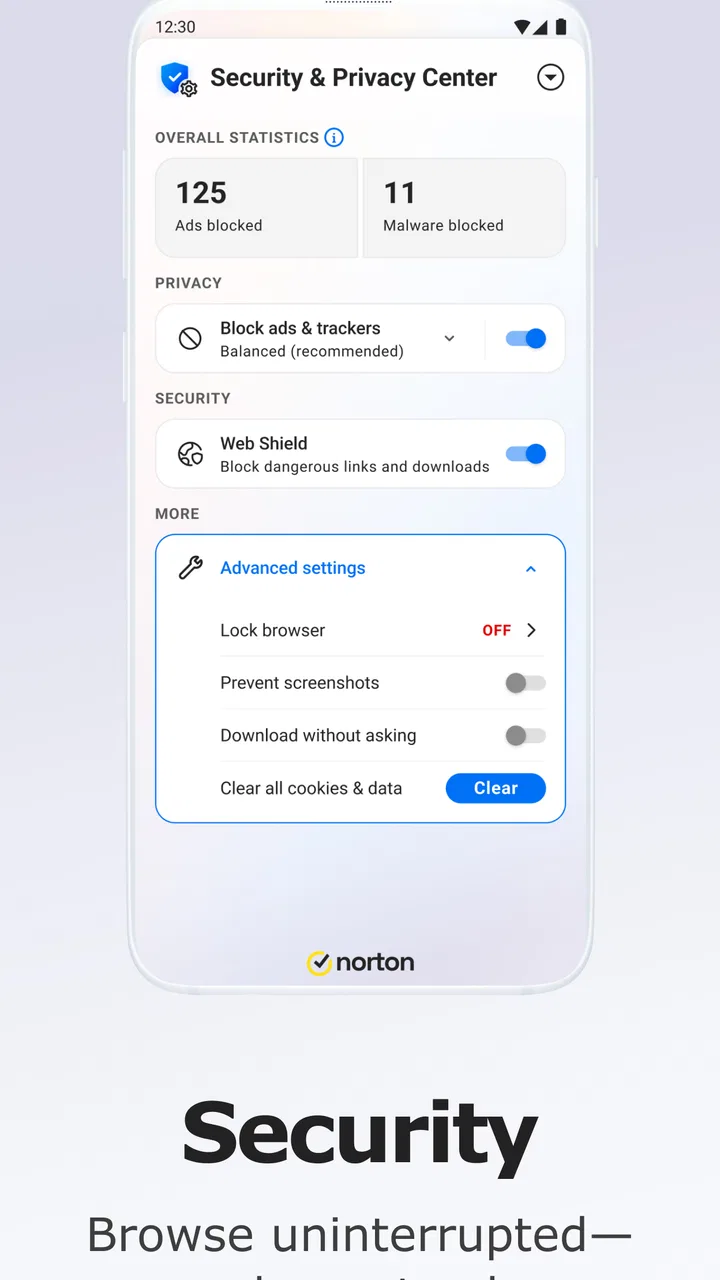
A realistic example is a link sent in a chat. I tap it because I need one piece of information, but the page opens with banners, autoplay elements, pop-ups, and several distractions competing for attention. In that situation, Norton Private Browser has an obvious purpose: it gives me a separate place to open the page while its AdBlock focus works in the background.
That separation is useful because I do not have to change the browser I use for every task. I can keep my usual setup for work, saved accounts, or sites that I already know well, then send a particularly advertising-heavy page into Norton’s browser. This makes the app more practical as a second browser than as an automatic replacement for everything.
The first handoff matters. A browser is only convenient if links from messaging, email, notes, or social apps reach it without making me copy and paste unnecessarily. When the system offers Norton Private Browser as an option, the workflow is simple: choose it, let the page load, and continue reading. If I am already inside the app, I can also start from its address or search field instead of waiting for another application to pass a link across.
I would not describe this as a dramatic change to how the internet works. It is a small but useful adjustment to the starting condition. Instead of accepting every page exactly as it arrives, I have a browser ready for situations where advertising makes the page harder to use. That is the role I think it handles best.
Reading the page instead of negotiating with it
Once the page opens, the main benefit is not simply that fewer advertisements may appear. The more important benefit is reduced interruption. A page with fewer promotional blocks is easier to scan, especially on a phone where screen space is limited. I can reach the article, product information, or instructions with less visual competition.
This is particularly helpful when I am using a phone on a slower or busy connection. I would not promise that every site will suddenly load instantly, because websites vary widely and advertising is only one part of loading time. Still, blocking unnecessary advertising content can make a page feel less crowded and may reduce the amount of material arriving before I can read what I came for.
There is also a practical privacy angle to the browser’s positioning. I prefer not to treat “private” as a magic word that makes every online activity anonymous. It is better understood as a reason to choose this browser when I want a more privacy-minded browsing environment. I still need to think carefully about the accounts I use, the information I enter, and the sites I visit. A private browser does not remove the need for sensible online habits.
My advice is to judge the app by the pages that cause you trouble. If your main problem is aggressive advertising, the difference should be noticeable in the way you move through those pages. If your main concern is advanced account management, developer tools, or a highly customized browser workspace, the ad-blocking focus may not be enough to replace a more established general-purpose browser.
Handling sign-ins and the point where browsing becomes personal
The workflow changes as soon as a page asks me to sign in. Reading a public page and accessing a personal account are not the same task, so I pause before entering credentials. A separate privacy-focused browser can be useful for sensitive browsing, but it also means I need to remember where I started a session and which browser is holding it.
This is one of the app’s less obvious trade-offs. Using a second browser can reduce clutter and separate activities, but it can also split my browsing history and active sessions between applications. If I begin a purchase in one browser and later look for the confirmation in another, the handoff becomes my responsibility. I have to remember which app contains the tab and whether I am signed in there.
For occasional searches, that is not a serious problem. For someone who manages many work accounts, shopping logins, or frequently used services, it can become friction. I would choose Norton Private Browser for focused browsing rather than assuming it will automatically simplify every account-based workflow.
There is a useful habit here: before signing in, decide whether the task is temporary or ongoing. For a one-time look at a service, the browser’s privacy-oriented role makes sense. For a service I return to throughout the day, I may prefer the browser where my normal login routine and account handoffs already feel natural. That decision prevents the app from becoming another place I have to search later.
Moving between tabs, apps, and the final result
After finding the information I need, the next handoff is often more important than opening the page. I may copy a detail into a note, share a product page with a friend, or return to the chat that originally contained the link. Norton Private Browser fits this kind of short loop well: open, read, act, and leave.
The app’s value is strongest when the outcome is clear. I might confirm an opening time, read instructions, compare a few details, or check a page that was unpleasant in another browser. In these cases, blocking advertising is not the destination; it is what helps me reach the destination with fewer interruptions.
For longer research, I become more aware of the browser choice. I may need to collect several pages, compare information, return to an earlier result, and share links with other people. A browser that is familiar and deeply integrated with my existing devices may still be more convenient for that extended process. Norton Private Browser can take part in it, but I would not choose it solely because its store summary promises faster browsing. The real test is whether its cleaner experience outweighs the inconvenience of splitting the research across browsers.
One practical tip is to use it as a deliberate “clean reading” step. When a link arrives in a busy app, open it here first to decide whether the page is useful. If it is, continue; if it is not, close it without letting that page become part of the browser I use for everything else. This keeps the app’s purpose clear and avoids creating unnecessary duplication.
Where the flow breaks
The biggest limitation is that ad blocking can interfere with the way some websites expect to operate. A page may depend on advertising-supported content, a consent prompt, embedded media, or a script that is treated as part of the page’s normal structure. When something does not load correctly, I may need to refresh, try another browser, or temporarily use the site’s own preferred environment.
That is not a reason to dismiss the app; it is the normal trade-off of filtering web content. The cleaner the page becomes, the more important it is to recognize that some sites may not behave exactly as their publishers intended. I would especially avoid relying on one browser for an urgent form, a time-sensitive booking, or a service I have not tested before.
Another break occurs when I expect the browser to replace every tool I already use. People who depend on tightly connected passwords, synchronized tabs, extensive extensions, or a familiar desktop-to-phone workflow may find a second browser less convenient. Norton Private Browser’s appeal is focused, not universal. It addresses a particular browsing problem rather than eliminating every reason to use another browser.
There is also a mental handoff to consider. Privacy is partly a product choice and partly a behavior choice. If I open a private browser but then share sensitive information carelessly, use weak passwords, or forget which account is active, the browser alone cannot correct those habits. I appreciate the privacy emphasis, but I would not treat it as a complete security plan.
How it compares with the usual browser choices
Compared with the browser that comes preinstalled on a phone, Norton Private Browser feels more purpose-built for people who want advertising control without first searching through settings or adding separate tools. The advantage is clarity: I know why I am opening it. The disadvantage is that my normal browser may already be better connected to my phone, accounts, history, and other devices.
Compared with a mainstream browser that offers optional privacy settings, Norton’s straightforward identity is appealing. I do not have to turn the app into a project before using it for a cleaner session. However, mainstream alternatives often win for broad compatibility and continuity. If I move constantly between a phone, tablet, and computer, that continuity may matter more than having a dedicated ad-blocking browser.
Compared with a browser chosen mainly for deep customization, this app is easier to understand but may feel less suitable for people who want to tune every part of their setup. I would choose it for a focused workflow: open a page, reduce advertising distractions, protect the separation between browsing activities, and finish the task. I would choose another option when my priority is a large ecosystem of tools and integrations.
Who should install it, and who should skip it
I think Norton Private Browser is a good fit for someone who regularly encounters pages overloaded with advertising and wants a free browser ready for those moments. It also suits people who prefer to separate casual link opening from their primary browser, especially when a page comes from a chat or email and does not deserve a permanent place in their main browsing routine.
It is less convincing for someone who wants only one browser across every device and account. If your current browser already gives you the privacy controls, synchronization, and compatibility you need, adding another app may create more handoffs than benefits. The same applies to people who rely on websites that frequently break when advertising or tracking-related elements are filtered.
Families may appreciate that the app is rated for Everyone, but that rating should not be confused with supervision. A browser can be appropriate for a broad age range while children still need guidance about links, downloads, accounts, and personal information. I would treat the age rating as an accessibility signal, not as a replacement for family settings or conversation.
What the current release tells me
The app was released on November 25, 2024, and the current version is 8.19.0. That gives me a clear point of reference when deciding whether to try it: I am looking at a relatively recent product rather than an old browser that has simply remained available. It is developed by NortonMobile, a name that will be familiar to people who already associate Norton with privacy and security products.
I still recommend judging the current experience on your own phone and with your own regular websites. Browsers are unusually dependent on the pages they open, and a smooth result on one site does not guarantee the same result on another. The most sensible test is a short, low-risk workflow: open a link that is annoying in your usual browser, read the page, try any normal interaction you need, and then decide whether the cleaner experience is worth keeping.
My final outcome after using the workflow
Norton Private Browser works best as a practical second browser with a clear job. I open it when I want a more private-feeling environment and fewer advertising distractions, follow the link through to the information I need, and then hand the result back to a note, message, or other app. That flow is simple, and the free price makes experimenting easy.
Its limits are just as important. It does not remove the need for careful browsing, and it may not be the best home for every login, tab, or long research project. Filtering can occasionally create friction, while using a separate browser can divide sessions and history. Those are real costs, not reasons to hide the app, and they help define the right audience.
My recommendation is therefore specific: install it if advertising-heavy pages are a regular annoyance or if you want a dedicated place for links you would rather not open in your main browser. Keep another browser available for complex account work, synchronized research, or sites that do not cooperate with filtering. Used in that focused way, Norton Private Browser feels more useful than its short description suggests, because it turns a messy link-opening moment into a cleaner, more controlled path to the result.
FAQs for Norton Private Browser
01What is Norton Private Browser and how does it enhance my online privacy?
Norton Private Browser is a secure web browser designed to protect your online privacy. It blocks ads, trackers, and unwanted cookies, ensuring a more private browsing experience. It also includes a built-in VPN for encrypted internet traffic, keeping your data safe from hackers and prying eyes. These features collectively provide enhanced privacy and security while you browse.
02Is Norton Private Browser available on both Android and iOS platforms?
Yes, Norton Private Browser is available for both Android and iOS devices. You can download it from the Google Play Store for Android or the App Store for iOS. This cross-platform availability ensures that users can enjoy a secure browsing experience on their preferred mobile devices without compromising on functionality or security.
03How does Norton Private Browser handle ad-blocking and tracker prevention?
Norton Private Browser comes with built-in ad-blocking and tracker prevention features. It automatically blocks intrusive ads and prevents websites from tracking your online activity. This helps in reducing page load times and improving your browsing experience. By limiting the data that websites can collect, it also enhances your online privacy and security.
04Does Norton Private Browser include any parental control features?
Norton Private Browser itself does not include specific parental control features. However, it provides a secure browsing environment that can be part of a broader parental control strategy. For comprehensive parental controls, Norton offers separate solutions that can be integrated with other security tools to monitor and manage children's online activities effectively.
05Is a subscription required to use Norton Private Browser, and are there any additional costs?
Norton Private Browser is free to download and use, but some advanced features, like the built-in VPN, may require a Norton 360 subscription. The VPN enhances security by encrypting internet traffic. While you can enjoy basic browsing features for free, opting for a subscription provides access to the full range of security and privacy tools offered by Norton.
Pros
- User-friendly interface enhances browsing experience.
- Built-in ad blocker reduces unwanted interruptions.
- Automatic HTTPS ensures secure connections.
- Incognito mode prevents tracking and data storage.
- Customizable privacy settings for user control.
Cons
- Limited extension support compared to other browsers.
- Occasional slow loading times on certain websites.
- Some sites may not display correctly with ad blocker.
- Requires frequent updates for optimal performance.
- Limited customer support for troubleshooting issues.

Norton Private Browser
Gallery